 For decades, environmentalists have been warning that human economic activity is exceeding the planet's limits. Of course we keep pushing those limits back with clever new technologies; yet living systems are undeniably in decline.
These trends need not be in conflict�in fact, there are fortunes to be made in reconciling them.
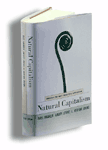
Natural Capitalism: Creating the Next Industrial Revolution, by Paul Hawken, Amory Lovins, and L. Hunter Lovins, is the first book to explore the lucrative opportunities for businesses in an era of approaching environmental limits.
In this groundbreaking blueprint for a new economy, three leading business visionaries explain how the world is on the verge of a new industrial revolution�one that promises to transform our fundamental notions about commerce and its role in shaping our future. Natural Capitalism describes a future in which business and environmental interests increasingly overlap, and in which businesses can better satisfy their customers' needs, increase profits, and help solve environmental problems all at the same time.
Natural capital refers to the natural resources and ecosystem services that make possible all economic activity, indeed all life. These services are of immense economic value; some are literally priceless, since they have no known substitutes. Yet current business practices typically fail to take into account the value of these assets�which is rising with their scarcity. As a result, natural capital is being degraded and liquidated by the wasteful use of such resources as energy, materials, water, fiber, and topsoil.
The first of natural capitalism's four interlinked principles, therefore, is radically increased resource productivity. Implementing just this first principle can significantly improve a firm's bottom line, and can also help finance the other three. They are: redesigning industry on biological models with closed loops and zero waste; shifting from the sale of goods (for example, light bulbs) to the provision of services (illumination); and reinvesting in the natural capital that is the basis of future prosperity.
Citing hundreds of compelling stories from a wide array of sectors, Natural Capitalism shows how these four changes will enable businesses to act as if natural capital were being properly valued, without waiting for consensus on what that value should be. Even today, when natural capital is hardly accounted for on corporate balance sheets, these four principles are so profitable that firms adopting them can gain striking competitive advantage�as early adopters are already doing. These innovators are also discovering that by downsizing their unproductive tons, gallons, and kilowatt-hours they can keep more people, who will foster the innovation that drives future improvement.
Natural Capitalism's preface states: "Although [this] is a book abounding in solutions, it is not about 'fixes.' Nor is it a how-to manual. It is a portrayal of opportunities that if captured will lead to no less than a transformation of commerce and of all societal institutions. Natural capitalism maps the general direction of a journey that requires overturning long-held assumptions, even questioning what we value and how we are to live. Yet the early stages in the decades-long odyssey are turning out to release extraordinary benefits. Among these are what business innovator Peter Senge calls 'hidden reserves within the enterprise'�'lost energy,' trapped in stale employee and customer relationships, that can be channeled into success for both today's shareholders and future generations. All three of us have witnessed this excitement and enhanced total factor productivity in many of the businesses we have counseled. It is real; it is replicable�"
The next Industrial Revolution has already started. Natural Capitalism will prepare you to be a part of it.
MORE: http://www.natcap.org/sitepages/pid5.php


1 comment:
Thank You James Ross for your post on Natural Capitalism. There has been an increase of interest lately as to what the term "Natural Capital" really is.
Each project that comes under consideration for SEND to work with needs to have an assesment of how the project will align itself with these principles and in turn the principles of Natural Capital resources will align themselves with the project. When this synergy is reached the project will in a sense achieve an equalibrium like state. Then the hard work is for the most part done and the project should just need minor course corrections from time to time with a minimum of energy input. It is then that the returns are consistant on all sides of the equation. Also this should be the time to really be able to maximize the learning curve. Since the dynamics of how the various elements and their interelationships will become more apparent. It is then that the project with all of the resources involved, including people can grow and evolve to the next level or levels. AS the process of life unfolds and people can truly begin to comprehend how they can effect a positive change,by respecting lifes Natural Capital (especially themselves)their capacity to effect those changes will increase exponentially. It is then that the quality of life will begin to take a positive sustainable turn.
Post a Comment