

A home wind turbine already installed at 250 sites in Scotland is now being sold across the pond.
Cascade Engineering said Monday the Swift wind turbine, for homes and other buildings, is available in the U.S. and Canada.
 (Credit: Cascade Engineering)
The Swift tries to set itself apart from existing small wind turbines with a design that reduces noise. Also, the turbine can be attached to a home, rather than to a free-standing pole or tower.
Like other wind turbines, the Swift has blades that turn and power a generator. But rather than the typical three blades, the Swift has five and a ring that goes around them. That "outer diffuser" ring cuts the noise level to 35 decibels and reduces vibration, according to the company.
The turbine, with a 7-foot diameter, also has two fins to direct the turbine to face the wind. It can turn 360 degrees and shut down if the wind is too high.
It can generate 1.5 kilowatts with 14 mile-per-hour wind and about 2,000 kilowatt-hours over a year, the company said. U.S. households typically consume between 6,500 and 10,000 kilowatt-hours in a year, according to the U.S. Energy Information Administration.
At a cost of $10,000 installed, it's a bit lower than the typical per-watt cost of solar electric panels. But state rebates, the cost of electricity, and the wind or solar resource make a big difference on the actual up-front cost. Cascade estimates the payback on the upfront cost can be as low as three years, but that it varies widely.
 (Credit: Cascade Engineering)
Small wind recently benefited from the extension of renewable energy tax credits, which gives consumers a $1,000 tax credit for residential systems and $4,000 for commercial buildings.
Cascade, which is based in Grand Rapids, Mich., has installed 9 Swift turbines in the U.S. and has a backlog of 25 orders, according to Jessica Lehti, the company's senior product marketing manager.
The mix of customers is spit in half between residential and commercial customers. Even with the economic downturn, the company expects that it can sell to customers who purchase renewable energy products for both economic and environmental reasons.
Cascade, which specializes in plastics, has partnered with the Scotland-based Renewable Devices, which originally designed the Swift. Cascade is selling the product in the U.S.
The company says the turbine is best suited for places with average winds and needs to be placed two feet above the roofline.


Today's students will enter a job market that values skills and abilities far different from the traditional workplace talents that so ably served their parents and grandparents. They must be able to crisply collect, synthesize, and analyze information, then conduct targeted research and work with others to employ that newfound knowledge. In essence, students must learn how to learn, while responding to endlessly changing technologies and social, economic, and global conditions.
Traditional academic approaches -- those that employ narrow tasks to emphasize rote memorization or the application of simple procedures -- won't develop learners who are critical thinkers or effective writers and speakers. Rather, students need to take part in complex, meaningful projects that require sustained engagement and collaboration.
Listen to education expert Linda Darling-Hammond's insights on cooperative teaching in the Edutopia video The Collaborative Classroom: An Interview with Linda Darling-Hammond [1]. Darling-Hammond, a professor of education at Stanford University and former director of the National Commission on Teaching and America's Future, was chosen in 2006 by Education Week as one of the nation's ten most influential people affecting education policy over the last decade.
She and article coauthor Brigid Barron are two of the coauthors of Powerful Learning: What We Know About Teaching for Understanding, a review of research on the most effective K-12 teaching practices. In the book, copublished by Jossey-Bass and The George Lucas Educational Foundation, the authors explore the ways in which project learning, cooperative learning, and performance-based assessment generate meaningful student understanding in the classroom. Available for puchase at amazon.com [2].  [3] Download an expanded version of this article [3] adapted from the book (PDF 7.6MB).
But what types of teaching and learning will develop these skills? And, just as important, do studies exist that support their use?
A growing body of research demonstrates that students learn more deeply if they have engaged in activities that require applying classroom-gathered knowledge to real-world problems. Like the old adage states, "Tell me and I forget, show me and I remember, involve me and I understand."
Research shows that such inquiry-based teaching is not so much about seeking the right answer but about developing inquiring minds, and it can yield significant benefits. For example, in the 1995 School Restructuring Study, conducted at the Center on Organization and Restructuring of Schools by Fred Newmann and colleagues at the University of Wisconsin, 2,128 students in twenty-three schools were found to have significantly higher achievement on challenging tasks when they were taught with inquiry-based teaching, showing that involvement leads to understanding. These practices were found to have a more significant impact on student performance than any other variable, including student background and prior achievement.
Similarly, studies also show the widespread benefits of cooperative learning, in which small teams of students use a variety of activities to more deeply understand a subject. Each member is responsible not only for learning what is taught but also for helping his or her teammates learn, so the group become a supportive learning environment.
What follows is a summary of the key research findings for both inquiry-based and cooperative learning. First, let's look at three inquiry-based approaches: project learning (also called project-based learning), problem-based learning, and design-based instruction.
Project learning involves completing complex tasks that result in a realistic product or presentation to an audience. "A Review of Research on Project-Based Learning," prepared by researcher John Thomas for the Autodesk Foundation, identified five key components of effective project learning:
Research on project learning found that student gains in factual learning are equivalent or superior to those of students in more traditional forms of classroom instruction. The goals of project learning, however, aim to take learning one step further by enabling students to transfer their learning to new kinds of situations, illustrated in three studies:
Other short-term, comparative studies demonstrated benefits from project learning, such as increases in the ability to define problems, reason with clear arguments, and plan projects. Additional research has documented improvements in motivation, attitude toward learning, and work habits. Students who struggle in traditional instructional settings have often excelled when working on a project, which better matches their learning style or preference for collaboration.
Problem-based-learning approaches are a close cousin of project learning, in which students use complex problems and cases to actively build their knowledge. Much of the research for this approach comes from medical education. Medical students are given a patient profile, history, and symptoms; groups of students generate a diagnosis, conduct research, and perform diagnostic tests to identify causes of the pain or illness. Meta-analyses of multiple studies have found that medical students in problem-based curricula score higher on clinical problem solving and performance.
Use of problem-based cases in teacher education has helped student teachers apply theory and practical knowledge to school contexts and classroom dilemmas; these cases, for example, have enabled teachers to take alternative perspectives to better appreciate cultural diversity.
Studies of problem-based learning suggest that it is comparable, though not always superior, to more traditional instruction in teaching facts and information. However, this approach has been found to be better in supporting flexible problem solving, reasoning skills, and generating accurate hypotheses and coherent explanations.
Design-based instruction is based on the premise that children learn deeply when they create products that require understanding and application of knowledge. Design activity involves stages of revisions as students create, assess, and redesign their products. The work often requires collaboration and specific roles for individual students, enabling them to become experts in a particular area.

Design-based approaches can be found across many disciplines, including science, technology, art, engineering, and architecture. Design competitions for students include the FIRST [5] robotics competitions and Thinkquest [6], for which student teams design and build Web sites on topics including art, astronomy, computer programming, foster care, and mental health.
Thinkquest teams are mentored by a teacher who gives general guidance throughout the design process, leaving the specific creative and technical work to the students. Teams offer and receive feedback during a peer review of the initial submissions and use this information to revise their work. To date, more than 30,000 students have created more than 7,000 Web sites [7] through this competition.
Few studies have used a control group to evaluate the impact of the learning-by-design model, but in a 2000 study by researchers C.E. Hmelo, D.L Holton, and J.L. Kolodner, sixth-grade students designed a set of artificial lungs and built a partially working model of the respiratory system. The learning-by-design students viewed the respiratory system more systemically and understood more about the structures and functions of the system than the control group.
Hmelo and colleagues argued that design challenges need to be carefully planned, and they emphasized the importance of dynamic feedback. They also determined that teachers working on design projects must pay particular attention to finding a balance between students' work on design activities and reflection on what they are learning; that balance allows teachers to guide students' progress, especially in recognizing irrelevant aspects of their research that may take them on unproductive tangents, and in remaining focused on the whole project rather than simply on its completion.
A significant challenge to implementing inquiry approaches is the capacity and skill of teachers to undertake this more complex form of teaching. Teachers may think of project learning or problem-based teaching as unstructured and may fail to provide students with proper support and assessment as projects unfold.
When students have no prior experience with inquiry learning, they can have difficulty generating meaningful driving questions and logical arguments and may lack background knowledge to make sense of the inquiry. Students can neglect to use informational resources unless explicitly prompted. They can find it hard to work together, manage their time, and sustain motivation in the face of setbacks or confusion.
One of the principal challenges for teachers, then, is to learn how to juggle a host of new responsibilities -- from carving out the time needed for extended inquiry to developing new classroom-management techniques. They must also be able to illuminate key concepts, balance direct instruction with inquiry teaching, facilitate learning among groups, and develop assessments to guide the learning process. That's a tall order for even the most experienced teacher.
To address these problems, Alice D. Gertzman and Janet L. Kolodner, of the Georgia Institute of Technology, introduced the concept of a design diary in 1996 to support eighth-grade science students in creating a solution for coastal erosion on a specific island off the coast of Georgia. Students had access to stream tables, as well as resources on videotape and the Internet.
In a first study conducted by Gertzman and Kolodner, learning outcomes were disappointing but instructive: The researchers noted that the teacher missed many opportunities to advance learning because she could not listen to all small-group discussions and decided not to have whole-group discussions. They also noted that the students needed more specific prompts for justifying design decisions.
In a second study, the same researchers designed a broader system of tools that greatly improved the learning outcomes. These tools included more structured diary prompts asking for design explanations and the use of whole-class discussions at strategic moments. They also required students to publicly defend their designs earlier in the process. Requiring students to track and defend their thinking focused them on learning and connecting concepts in their design work.
Inquiry-based learning often involves students working in pairs or groups. Cooperative small-group learning -- that is, students working together in a group small enough that everyone can participate on a collective task -- has been the subject of hundreds of studies. All the research arrives at the same conclusion: There are significant benefits for students who work together on learning activities.
In one comparison by Zhining Qin, David Johnson, and Roger Johnson, of four types of categories for problems presented to individuals and cooperative teams, researchers found that teams outperformed individuals on all types and across all ages. Results varied by how well defined the problems were (a single right answer versus open-ended solutions, such as writing a story) and how much they relied on language. Several experimental studies have shown that groups outperform individuals on learning tasks and that individuals who work in groups do better on later individual assessments.
Cooperative group work benefits students in social and behavioral areas as well, including improvement in student self-concept, social interaction, time on task, and positive feelings toward peers. Researchers say these social and self-concept measures were related to academic outcomes and that low-income students, urban students, and minority students benefited even more from cooperative group work, a finding repeated over several decades.
But effective cooperative learning can be difficult to implement. Researchers identify at least three major challenges: developing group structures to help individuals work together, creating tasks that support useful cooperative work, and introducing discussion strategies that support rich learning.
A great deal of work has been done to specify the kinds of tasks, accountability, and roles that help students collaborate well. In a summary of forty years of research on cooperative learning, Roger and David Johnson, at the University of Minnesota, identified five important elements of cooperation across multiple classroom models:
Cooperative-learning approaches range from simply asking students to help one another complete individually assigned problem sets to having students collectively define projects and generate a product that reflects the work of the entire group. Many approaches fall between these two extremes.

In successful group learning, teachers pay careful attention to the work process and interaction among students. As Johns Hopkins University's Robert Slavin argues, "It is not enough to simply tell students to work together. They must have a reason to take one another's achievement seriously." Slavin developed a model that focuses on external motivators, such as rewards and individual accountability established by the teacher. He found that group tasks with individual accountability produce stronger learning outcomes.
Stanford University's Elizabeth Cohen reviewed research on productive small groups, focusing on internal group interaction around tasks. She and her colleagues developed Complex Instruction [8], one of the best-known approaches, which uses carefully designed activities requiring diverse talents and interdependence among group members. Teachers pay attention to unequal participation, a frequent result of status differences among peers, and are given strategies to bolster the status of infrequent contributors. Roles are assigned to encourage equal participation, such as recorder, reporter, materials manager, resource manager, communication facilitator, and harmonizer.
Studies identified social processes that explain how group work supports individual learning, such as resolving differing perspectives through argument, explaining one's thinking, observing the strategies of others, and listening to explanations.
Evidence shows that inquiry-based, collaborative approaches benefit students in learning important twenty-first-century skills, such as the ability to work in teams, solve complex problems, and apply knowledge from one lesson to others. The research suggests that inquiry-based lessons and meaningful group work can be challenging to implement. They require changes in curriculum, instruction, and assessment practices -- changes that are often new for teachers and students.
Teachers need time and a community to organize sustained project work. Inquiry-based instruction can help teachers deepen their repertoire for connecting with their peers and students in new and meaningful ways. That's powerful teaching and learning -- for students and teachers alike.
Create the right skill sets through professional co-op
 Is the United States producing the right skills sets in preparing innovators and engineers?
“It’s been a topic of interest for some time,” says Kettering University Provost and Vice President for Academic Affairs Michael Harris.
The results of a national survey of employers’ ratings of the abilities of recent grads in 12 specific skill areas indicated that employers are not giving high marks to the skills of graduates either. The survey, conducted by Peter D. Hart Research Associates for the American Association of College and Universities, asked employers to rate new hires in the skills that represent a growing consensus regarding the abilities necessary to succeed in the 21st Century workforce.
Harris said of the employers surveyed in the AACU survey, 83 percent said that they would like to see evidence of graduates’ ability to apply college to a “real-world setting” through faculty assessments of internship projects and community-based work. The Accrediting Board for Engineering and Technology has recognized this challenge and has begun to take steps in addressing this need for change. The new ABET standards, known as EC2000, ask programs to set clear educational objectives, to collaborate with industry, to conduct outcomes assessment and feed data from these assessments back into the program for continuous improvement.
“The challenge we face is further increased as a result of the downsizing of manufacturing operations in some of our largest corporations, coupled with the offshore movement of low-skilled jobs,” Harris said. “This has created a public misconception that technical fields like engineering, and even the sciences, are no longer good areas for intellectual and career pursuit thus contributing to the very real decline in students seeking engineering degrees. Ironically, the same corporations that are downsizing are also experiencing unprecedented shortages of the workforce skills necessary to carry out their product strategies globally.”
 Harris said the challenge requires a different educational paradigm and close collaboration between higher education and business and industry.
“Kettering University offers a learning model that combines two distinct learning environments -- an on-campus academic experience and a cooperative education work experience -- where students gain knowledge and skills relevant to working and living in a complex world," Harris said. "A Kettering education combines cutting-edge theory and practical application. The co-op experience is a transformative process through which students become increasingly acclimated and socialized to the corporate environment as they increase their knowledge-base and theoretical understanding of their discipline.”
Co-op education at Kettering, with more than 600 co-op sponsors, provides the opportunity for employers to take part in that transformative process and create the new hires they seek. “We can do so by increasing the cooperation and coalition building between higher education and industry, working together toward a common goal,” Harris added.
To read more about Kettering’s co-op program, visit www.kettering.edu.

Creative Cities Summit 2.0 Recap by Arnold Weinfeld
Director of Public Policy & Federal Affairs for the League
October 13, 2008
 This week, the second-ever Creative Cities Summit will be taking place in Detroit at the Renaissance Center. The League has been working with event founder Peter Kageyama and a host of other organizations over the last several months on putting together an event that will feature speakers from around the world with knowledge and experience in creating vibrant communities. I'm looking forward to hearing from people such as Richard Florida, Charles Landry, John Howkins, Doug Farr, Bill Strickand and a host of others. Session content covers a wide array of topics from cities and universities; attracting and retaining talent (this one features League CEO Dan Gilmartin); design; marketing and media; transportation; music and creativity; and sustainability, just to mention a few. It all starts today and runs through Wednesday. I'll be reporting highlights throughout the week. For a full agenda check out www.creativecitiessummit.com.
October 14, 2008
As the Creative Cities Summit opened on Monday in Detroit, Karen Gagnon, Cool Cities director and CCS2 (Creative Cities Summit 2) co-producer, asked people to take away one big idea. Yet the first day speakers revealed several concepts that when woven together bring to mind the big idea that cities hold the key to creating the environment necessary for creativity.
As Pier Giorgio Di Cicco, author of The Municipal Mind noted, creativity is impossible without the civil encounter, for the city is the place where one discovers his/her destiny through others. Di Cicco also spoke about how risk taking is essential to creative economies as much as good urban citizenship is a key to knowledge economy. He was followed by John Howkins, one of the first to publish ideas on creativity and innovation in the 2001 work, The Creative Economy, and a consultant who has worked in over 30 countries—most recently in China. He began by noting how China will achieve in 30 years, the kind of urbanization it took Europe nearly 2,000 years. Howkins said the creative economy sees more failures than the service or manufacturing economies and that global competition in the 21st century is minds vs minds and copyright vs copyright, or minds working with other minds. He set forth his principles of 'creative ecology' whereby everyone is considered to be creative; creativity needs freedom and freedom needs markets. Howkins said creativity is not simply art or innovation but imagination, dreams, new concepts, design, culture, style, and meaning.
Freedom is dialogue, collaboration, education, training, learning, and acceptance by family/friends/society. The market is the marketplace of ideas as evidenced through information content and the internet. The creative ecology is one where diverse individuals express themselves in a systematic and adaptive way using ideas to produce new ideas. According to Howkins, the six indicators of the creative ecology are systems, diversity, change, learning, adaptation, and sustainability. The next billion of those looking for work will go to creative cities to join the creative ecology.
Bill Strickland concluded with his inspirational story of the Manchester Craftsmen's Guild and Bidwell Training Center in Pittsburgh, PA. Strickland's story and his vision are built around the premise that provided the right environment, people will go into the world as assets, not liabilities. To say the least, the first day of the summit was a day for listening and learning. Tuesday we'll hear more thoughts on the creative economy, creative city, and creative design from thinkers such as Richard Florida and Charles Landry, sustainable urbanist Doug Farr, as well as Ben Hecht of Living Cities and Tom Wujec of Autodesk, with breakout session topics covering LEED neighborhood development, transportation, and a discussion on the Midwest as a mega-region. Something tells me that it will be another day of big ideas. Stay tuned to more from the 'D' on these and other goings on at the CCS2!
October 15, 2008
You'll recall that I mentioned yesterday that if Monday's sessions were any indication then those speaking Tuesday would also have some big ideas for us to consider. Well I and those in attendance were not disappointed! The day began with Tom Wujec of Autodesk. Autodesk is the Oscar-winning industry leader in 3D computer animation technology. Tom discussed how teams foster their creativity, that innovation is the capacity to encourage imagination. He was followed by Ben Hecht, President and CEO of Living Cities. Living Cities is a national community redevelopment initiative that looks to improve the built environment in under-developed neighborhoods. Ben sees cities as the solution for solving America's problems—leading us into the green economy and building a new urban ecosystem through strong neighborhoods. He noted that venture capitalists are funding 'clean technology' initiatives right behind information technology and bio tech.
 We then heard from Doug Farr, a Detroit native and an architect, planner, and author of the book Sustainable Urbanism. Doug spoke about the foundations of sustainable urbanism—smart growth, green buildings, and new urbanism. He said that we need to change our culture and our systems when it comes to thinking about efficiency and sustainability, including fixing codes and reversing regulations. He noted that a part of the 2030 Communities Campaign is to reduce vehicle miles traveled; it is wrong to think we can all buy fuel efficient vehicles and drive more or build larger buildings simply because they’re 'green'.
Richard Florida was the lunch keynote speaker, and although he made the circuit a few times a number of years ago after penning the book The Rise of the Creative Class, it was the first time this writer had seen him speak. He has a new book out now titled Who's Your City? and his speech ran the gamut of topics from the current financial crisis to the role cities must play in providing the means for creativity. Florida opined that we are in the midst of a fundamental economic transformation and that the current worldwide financial crisis is not analogous to 1929, but rather to the late 1800s—the last time the world saw great economic system change. The change taking place now according to Florida is the move to a creative economy where the only real capital left is human capital or creativity. The old models of recovery are bankrupt and the only way out is through our communities. He noted that at the turn of the 20th century only five percent of the US was in creative economy; even in 1980 it was only 15-20 percent...now it is 33 percent. Creativity doesn't respect social boundaries...it has nothing to do with race, disabilities; etc. Rather than a “melting pot” he said we are now a “mosaic society” where an individual can keep their culture, their identity, and enjoy the culture and identity of others. Arts, culture, and entertainment are as important today as business, finance, and technology. In order to provide the means for fostering creativity, cities must provide 1) physical and economic security; 2) economic and civic opportunity; 3) leadership to activate the creativity; 4) open mindedness and being welcoming to all; and 5) quality of place including integration with the natural environment. And this just got us through lunch! I'll continue with more tomorrow including thoughts from Charles Landry and a historic roundtable discussion.
October 16, 2008
Day 2- Part 2
When I left off yesterday, Richard Florida had just given his manifesto of the way things are now and the way they should be. And, whether you’re a Richard Florida fan or not he definitely gives one something to think about.
Which takes us to after lunch on Tuesday and Charles Landry. Landry is known for his work on creativity and its uses and how city futures are shaped by paying attention to the culture of a place. He too has written books, his most recent, The Art of City Making focuses on how cities can be more "creative for the world." His comments reflected that belief as he noted that the art of city making in the 21st century is the art of living together. He said that there are many ways to look at a city but that first and foremost is its history and creativity. Having a strong arts and cultural heritage is synonymous with the creative economy. He noted that one of the challenges facing us is what to do with smaller 2nd-6th level cities. What is the emerging advantage when every city is chasing talent and being creative—it is values driven development connecting to a bigger picture. Cities need to learn to keep the best and reinvent the rest through capital assessments.
Landry also dug down into city organization providing a means by which cities must be open through a "creative bureaucracy" or one which is strategically principled but tactically flexible. One that is open to collaboration and partnership with its citizens and greater community.
Following Landry was a roundtable discussion which, for the first time, brought together the three people—Landry, John Howkins and Richard Florida—who for the past decade have spent their time writing and speaking about the creative economy, creative class, and creative city. The discussion was moderated by CEOs for Cities director Carol Coletta and a lively discussion ensued weaving together the thoughts of these thinkers. Some of the comments included Florida saying that the most basic right of any person is to be able to fully explore your talent through self expression and that cities must stop doing dumb things. They need to conserve resources, empower community groups. Reflecting on the current worldwide situation he noted that "a crisis is a terrible thing to waste.” John Howkins noted that creativity needs freedom and that we need to be investing in people. Landry noted that we have to shift the rule system away from the plantation mentality of the industrial system.
As full as the morning and afternoon session were, there was a after-dinner session with representatives from Google, MSU, U-M and WSU as well as private business and Lansing Mayor and MML Board member Virg Bernero to discuss cities, universities, and talent. Nearly everyone agreed that all need to work better together at retaining talent in Michigan.
Tuesday CCS2 sessions were about as full as they get with concepts and ideas on how we need to move forward to secure a better future. And after hearing speakers for the first two days, one thing is indeed clear... the world economic platform has changed to one in which brains are the new capital, not brawn. Those cities, states, regions, and countries that understand this and put in place systems that will encourage creative activity and growth in their communities will grow themselves.
October 17, 2008
After two days of speakers and presenters giving us more than one "big idea," the last day of the CCS2 was drill down day as many session speakers were from organizations working on the ground implementing those very ideas that help to create vibrant cities. In the opening plenary session, Doug Rothwell (president of Detroit Renaissance) and Kelly Lee (executive vice president of Innovation Philadelphia) spoke to their respective efforts at working to create places that will attract young, talented people. That was followed by breakout sessions involving such topics as music and economic development, planning for the creative city, and race and the creative city. This last topic explored the challenges, triumphs, and lessons learned from urban, creative professionals as they worked through racial barriers to spur social and economic innovation. The luncheon speaker was Diana Lind, editor of the magazine Next American City which seeks to link young, urban organizations around the country in an effort to engage that constituency in a quest for more livable cities. The afternoon sessions included discussions on storytelling or how to relate the authenticity of a place; the future of creative expression for cities; creative industry incubators; and a session on the city's role in attracting and retaining talent, featuring League CEO Dan Gilmartin.
The final keynote speaker of the conference was Majora Carter. A life-long resident of the South Bronx, Majora spoke of her belief that one should not have to move out of your neighborhood to live in a better one, and acted upon that belief by founding the non-profit environmental justice solutions corporation, Sustainable South Bronx (SSBx). Her first project was obtaining a federal planning grant for the South Bronx Greenway Project which led to the first new South Bronx water front park in over 60 years. She has continued to work on projects to improve her neighborhood, one of the poorest in New York City. Since starting the Bronx Environmental Stewardship Training Program in 2003, an urban green-collar job training and placement system, she has since partnered with Van Jones on a national green-collar job agenda. Majora is a inspiration to anyone working to make their corner of the world a better place.
For me, this three-day conference re-affirmed my belief that communities hold the key economic prosperity. It helped to coalesce those ideas and strategies that will help me in my work with communities in Michigan. One thing is clear, public and private sector leaders and citizens must understand that a new economic platform is upon us—one that is based around knowledge and creativity, where human capital is the most important element. Those that do and who work together to put in place systems that will encourage creative activity and growth; these are the places that will grow themselves.
I'm glad to be part of an organization that is working with communities in Michigan to help them move forward. Join us.

| Posted: Thursday, 16 October 2008 4:46PM Everything You Always Wanted To Know About Wind Power |
| With Michigan's growth in wind energy dependent on community adoption of the necessary wind siting laws, Michigan Citizen Planner is offering a "What You Need to Know about Wind Energy Siting and Policy Issues" workshop at nine locations throughout Michigan during December. Sponsored by Michigan Farm Bureau and Michigan State University, the three-and-a-half-hour workshops will provide planning and zoning officials, local leaders, concerned citizens, farmers and landowners interested in wind the tools and resources necessary to create and implement a strategic plan for wind energy development in their communities. The Wind Siting and Policy Issues workshops will cover an array of related issues, including: * Current status of wind energy development in Michigan Visit www.citizenplanner.msu.edu and click on "Training Info & Calendar" at the top of the page for workshop locations and dates or to register for the workshops. The MSU Land Policy Institute focuses on research and outreach related to land use and strategic growth in the New Economy. The Institute delivers innovative solutions, transitioning knowledge from land use experts to the community. The Land Policy Institute was founded in 2006. |
| © MMVIII WWJ Radio, All Rights Reserved. |
Oct 6, 2008, By Elaine Rundle
Found in: Green Initiatives
Cities are rolling out solar maps to let residents see who in their community has a solar installation and also learn about how much energy could be harnessed if their roof were decked out in solar panels.
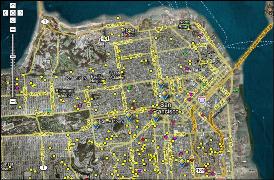
The San Francisco Department of the Environment launched the San Francisco Solar Map after the city set a lofty goal: to have 10,000 roofs equipped with solar power by 2012. The current count is 871. The solar map's goal is to offer residents and business owners a simple tool to learn about solar installation.
"We wanted something that would help people in San Francisco, that would break down some myths about installing solar in San Francisco, and then offer a tool to people who were interested in solar but didn't really know how to take the first step," said Johanna Partin, renewable energy program manager of the Department of the Environment.
The city presented the idea to engineering firm CH2M HILL in spring 2007. According to Ryan Miller, lead technologist for solar mapping initiatives for CH2M HILL, the solar map combines aerial photography, GIS software and client-supplied data, such as parcel maps and information from the tax assessor's database.
There are two aspects to the solar map: mapping existing solar installations and providing information for residents and business owners who are interested in installing solar panels.
Existing solar installations data points are mapped through the portal, incorporating characteristics of each installation, including system size, the amount of electricity it generates, the installer, a link to the installers' Web site, and an opportunity for the home or business owner to post photos and quotes. This information is displayed after users click on a dot on the map that represents each location where photovoltaic systems are installed.
For citizens interested in solar there's the option to type their address into the Web site and the technology identifies shading obstacles on the roof, such as HVAC units, skylights, perimeter walls or a taller building that could block sunlight, said Dave Hermann, client solutions director of CH2M HILL.
"It takes out the unusable space," Partin said. "It takes out the kind of north-facing side of the roof, if it's a pitch roof. It takes out the shaded areas; it takes out roof obstructions and those kinds of things."
The site estimates the amount of carbon dioxide that would be reduced, power output and system cost and size.
San Francisco uses Google Maps as the platform, but CH2M HILL said it is also able to create maps using Microsoft Virtual Earth and is working on implementations using ESRI solutions.
San Francisco hasn't yet received feedback from citizens that the solar map directly led to solar installation, Partin said, but the department has heard that potential customers use information garnered from the site when speaking with solar installers. She suspected the main driver is city grants for residents who install solar power.
The complete article will be published in the January 2009 issue of Government Technology.


