
The Energy Transformed Flagship program includes more than 20 research projects. Read about them here. http://www.csiro.au/csiro/channel/pchbe.html
The Energy Transformed Flagship program includes more than 20 research projects. Read about them here. http://www.csiro.au/csiro/channel/pchbe.html

A tech future at their fingertips
Lawrence Tech hosts a camp designed to get girls jazzed about math and computer science
July 29, 2007
In just 12 hours, 12-year-old Brielle Woods created a Web site that featured her favorite games, videos and music.
As she stood in front of a lecture hall at Lawrence Technological University in Southfield, Brielle talked about her Web site's features.
Pictures of puppies and links to online games and music videos were just some of what Brielle and the 21 other girls in the lecture hall had put on their Web sites.
The girls learned about creating Web sites and other forms of technology at Camp Infinity, July 16-20 at the university.
The girls also learned how to program robots. They planned a fashion show featuring their robots after their Web site presentations July 20.
"I like working with computers," said Brielle, who attends Ludington Magnet Middle School in northwest Detroit. "I would like to be a computer engineer or do something in Web design."
For four years, Camp Infinity has been sponsored by the Michigan Council of Women in Technology Foundation and hosted by Lawrence Tech.
The program is open to girls only, in fourth through seventh grades, who live in Oakland, Macomb and Wayne counties. It is free to the girls and is paid for by corporate sponsors. This year's program was paid for by a $34,000 grant from AT&T.
"This camp has two objectives," said Rosemary Bayer, president of the technology foundation. "The first is, you can do it and it's fun."
The second objective is that the girls pursue careers in the technology industry, where women are underrepresented. "The Michigan Council of Women in Technology started because there are very few women in the field," Bayer said. "I work for Sun Microsystems (in Southfield), and I looked around one day and realized I was the only woman there. We realized we needed to get more girls motivated and inspired about math and computer science."
Copyright © 2007 Detroit Free Press Inc.
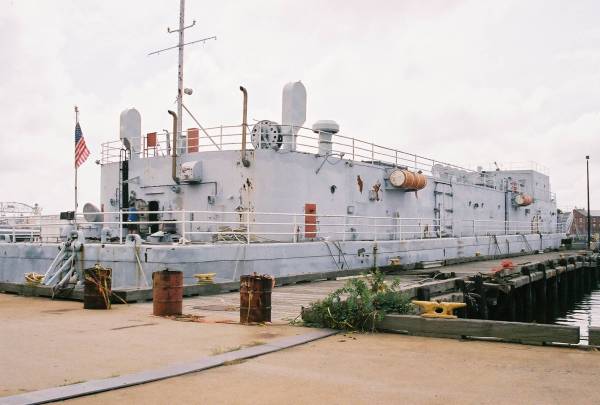
BARGE: Decommisioned from Active Military
More Pictures: http://www.maritimesales.com/SGA10.htm
This barge has been maintained in excellent condition by the military and was recently retired. Her steel looks very good as well with minor rust. When sold, if she is leaving the American flag, she must get government approval to do so.
There are 84 bunks and a fully equipped galley. Most equipment found to have less than 500 hours. The bottom Deck consists of 6 large cargo areas.
This barge is ideal for a fixed base or mobile dive, salvage, and or construction operation. There is plenty of room for offices and more than enough room for equipment storage, fabrication, and repair facilities. In addition this barge has the ability for an operation to be completely self-sustained.
This barge has current accommodations of 84 in bunks, it is felt that the number of bunks can be increased to perhaps 200 in air conditioned space. She has 6-7 large rooms with private bathrooms and a number of other rooms that could sleep people. Her two generators are currently operational, one has a minor problem that it is felt can be fixed easily. She also has a functional galley with working refrigerators and freezers. She has what appears to be a new water/fire alarm system in working condition. The capstan on the bow and stern operate.
Some of the rooms had wall mounted air conditioners that have been removed, and blanked off. She is relatively clean and the present owner is taking care of her. She is also presently insured and therefore insurable.
VESSEL IDENTIFIER: SGA10
Price: U.S. $ 750,000.00 FIRM
DIMENSIONS
Length 261 (feet) 79.5 ( meters)
Breadth 48 14/6
Height
Draft 9/13 2.7/3.9
Light Displacement 700 Tons
Generators 2 235 KW Marathon Generators powered by Detroit 12V71 Diesels
16 Hours on one 500 Hours on the other
Compressor 30 HP Gardner-Denver screw type with 273 Hours
Dive Compressors 2-Ingersall Rand high pressure and 4-medium pressure dive air compressors with tanks, flasks and related piping (all under 500 hours).
 For decades, environmentalists have been warning that human economic activity is exceeding the planet's limits. Of course we keep pushing those limits back with clever new technologies; yet living systems are undeniably in decline.
The NextEnergy Center in TechTown-the Wayne
State Research and Technology Park
| Wind Manufacturing Working Group | |||||||||||||||||||||
 | |||||||||||||||||||||

eSN TechWatch: Redefining 'intelligence' -- July 23, 2007
http://www.eschoolnews.com
 Futurist Andrew Zolli discusses the trends shaping education’s future—including the need to redefine what it means to be “smart.”
(CNN via Associated Press)
YouTube contributors pose a question to the Democratic presidential candidates at the debate in Charleston, S.C., on Monday night.
Crackdown in the classroom
Use a cell phone in Plymouth-Canton schools and you can wind up suspended
July 24, 2007
Plymouth-Canton Community Schools is getting tough on students caught using cell phones or iPods in school, going further than most districts in the state by punishing them with automatic suspensions for breaking the rules.
It's an unpopular move with students, but one that the district says is necessary to address a surge in violations of rules. The district says it tackles growing concerns about safety, security and students using electronic devices to cheat during class. And they expect other districts to follow suit
Instead of having the items confiscated and/or serving a detention, students now will be suspended -- one day for a first violation and up to five days for four or more violations.
"Will we have some people who will object? My gosh, of course. But if you look at the statistics, clearly you can see we've got to do something," said Bob Hayes, director for student services.
"This was not done capriciously. It's easy to punish. And punishment doesn't teach. We want to teach people responsible use," Hayes said.
Most districts in metro Detroit have policies similar to the previous rules in Plymouth-Canton, allowing devices on campus as long as they're off and out of sight, but officials in this Wayne County district believe they have good reason to bring down the hammer and suspend students instead of simply taking the devices away.
Hayes said the number of violations of the old policy prohibiting the use of electronic communications devices increased from 563 in 2005-06 to 1,374 in 2006-07. The surge, he said, is a sign that the previous penalties weren't enough of a deterrent.
Dealing with cheating
Cheating is one of the major reasons cited in a letter the district sent to summer school parents, and it is an area of increasing concern.
The Josephson Institute for Ethics in Los Angeles, in its annual report on ethics among American youth, reported that 60% of the 36,000 students surveyed in 2006 said they had cheated during a test at school within the previous 12 months; 35% said they had done so two or more times.
How often students use electronic devices to cheat is unknown.
Patrick Fitzpatrick, an assistant principal at Salem High School, said about 4% of the referrals he gets about students violating the policy on electronic devices are because they've been caught using the devices to cheat. Fitzpatrick is one of six assistant principals at the district's three high schools who handle discipline.
Savvy students can have their cell phones in their pocket and text message test answers to a friend, or ask a friend to give them an answer to a question. An iPod also can be used to cheat. Hayes said he's heard of students downloading difficult math or science formulas onto their iPods, then listening to the formulas during a test.
How do they avoid getting caught? They can hide the iPod in a pocket or under their clothing, snake the earphone cord through their shirt and cover the earpiece with a shirt collar, a hoodie or their hand.
Students are mixed about whether cheating is enough of a concern to warrant tougher penalties. Jing Guan, 17, of Canton, a junior at Plymouth High School, said she's seen students cheat by text-messaging answers to a test.
"Some kids are guilty, but they're treating everyone like they're guilty," Jing said.
But Brad Sullivan, a junior from Canton, said he doesn't think electronic cheating is a problem.
"Normally people cheat the old-fashioned way," said Brad, 16.
Michigan used to make this issue easy for schools. Up until 2004, all electronic devices were banned. But in 2004, the state left it up to districts to decide.
Safety and security
Local school administrators know how distracting, and disruptive, the devices can be, particularly in the classroom. One district, Southfield Public Schools, has more severe penalties for students who have a device that goes off during a class.
Safety and security also are key issues, Hayes said. If there were an emergency at the three high schools, and all students used their cell phones to call home, emergency workers would have a difficult time getting through to communicate with administrators.
Another concern, Hayes said, is that students have used their phones to text message or call each other to meet up for an anticipated fight.
Students not happy about it
Students acknowledge there is a problem, but say suspension isn't the answer.
"They need to get more strict, but they're taking it too far," said Scott Dreaver, 17, of Canton, a senior at Salem High School. He said he's had five violations and thought that automatic suspension would mean students will miss out on classroom work.
Students routinely ignore the rules, which are spelled out in the student code of conduct. Some of the students interviewed said that they never turn their cell phones off, and some acknowledge that they answer calls or text-message during the day. Some of the violations have been from parents calling their children during the school day.
The new penalties kicked in for summer school, but because of the abbreviated nature of the summer classes, a first offense got a three-hour detention instead of suspension. But while the message has clearly been sent, many students are still angry about it.
"There's not a day that goes by that people don't complain about it," said Lexa Dilmore, 16, a junior at Plymouth High School.
Contact LORI HIGGINS at 248-351-3694 or lhiggins@freepress.com.
Copyright © 2007 Detroit Free Press Inc.
YouTube revolutionizes debate
Democrats field online questions
July 24, 2007
CHARLESTON, S.C. -- Young, Internet-savvy voters challenged Democratic presidential hopefuls on gun control, the military draft and the candidates' place in a broken political system, playing starring roles in a provocative, video-driven debate Monday night.
"Wassup?" came the first question, from a voter named Zach, after another, named Chris, opened the CNN-YouTube debate with a barb aimed at the entire eight-candidate field: "Can you as politicians ... actually answer questions rather than beat around the bush?"
The answer was a qualified yes. The candidates faced blunt questions -- from earnest to the ridiculous -- and, in many cases, responded in kind.
To Sen. Barack Obama of Illinois: Are you black enough? "You know, when I'm catching a cab in Manhattan ... I'm giving my credentials," he replied.
To Sen. Hillary Rodham Clinton of New York: Are you feminine enough? "I couldn't run as anything other than a woman," she said, drawing a challenge from former Sen. John Edwards of North Carolina, who said he was the best women's advocate onstage.
One voter asked whether young women should register for the draft. Clinton, Obama and Sen. Chris Dodd of Connecticut said yes.
The debate featured questions submitted to the online video community YouTube and screened by CNN. A talking snowman, two rednecks and a woman speaking from her bathroom were among the twists to the oldest forum in politics: debate.
A Clio man asked about gun control while brandishing a firearm.
"He needs help," Sen. Joe Biden of Delaware snapped.
Copyright © 2007 Detroit Free Press Inc.
SEND-"The Flagship for change"
To become an integral force for the advancement of sustainable energy delivery systems in the Great Lakes Region and eventually worldwide. SEND will develop a platform specifically to conduct applied research, development and commercialization of environmentally harmonious energy systems for both industrial and residential applications. This platform will accommodate partnerships with industry and academic entities along with a core group of scientists, engineers and business human resources to conduct research and development of new technologies within the scope of renewable energy delivery systems.
SEND will draw upon the creative capital of its founders and funding from private and government grants to build a research vessel to test wind and hydraulic turbines. After measuring performance parameters of the core power system(s), applications will be developed for energy utilization and storage that are compatible with the marine environment. SEND will enter into partnerships with interested parties willing to share capital resources and technical expertise to test new applications that could lead to commercial products. SEND will also accommodate academic and privately funded internships for the purpose of education and technical training. Commercialization and intellectual property will be a separate entity, while the research and technology development is intended to be non-profit.
There are laws that have been broken and as a consequence there is a price that has to paid in order to right these wrongs. This is one of the basic tenets of the human made legal systems the world over. Is it not? The truth of these Laws under consideration here is irrefutable. These Laws are so right and honorable that one might even be moved to say “We hold these truths to be self evident”.
Well, you may be wondering, which legal system is under consideration here? Is it western law? Or perhaps it is Islamic law? Some people are already thinking “ laws are made to be broken” and the (assumed) Law of Averages is that I won’t be caught in one small indiscretion or perhaps even the successful completion of a really great caper. "Society can afford it, right?”
Other litigious type folks are lining up on both sides of the law ready and waiting to press the legal limits on both sides of the assumed to have been broken law.
The laws under consideration here are the Laws of the Universe. These are the laws or guidelines and context from which all life; organic, inorganic and spiritual are governed. The first identified transgression of these laws was documented millennia ago and is still a major news-breaking story. As a matter of fact the results of this crime have reverberated to such a degree that all of life on this planet is in jeopardy.
This was the fall from grace when humans began to believe that they were above the laws of the universe and could do as they pleased without regard or humility. These laws represent what people have come to call God. You may not believe in God , but you had better become acquainted with the Laws that govern your very existence. Because ignorance (and the supply of that is abundant) does not relieve you of the consequences of your actions or inactions.
This paper is not a thesis though or argument about who God is or isn’t.
This document is about identification of the problem and discovery of some answers.
Sustainable Energy Delivery LLC or SEND is about the business of doing it’s part to educate people about finding ways to live, work and play safely within these natural laws of our shared universe. There is a new awareness of an existing system of commerce. The system of commerce is Natural Capital development. Natural capital is simply the accumulated bounty accumulated by all life that has preceded you. Natural Capital development in human terms is working with this natural bounty in ways that do no harm and lay the groundwork for the next generation into infinity.
It is this interest or bounty, that the industrial world has rapidly consumed to the point of which we are witnessing the collapse of the very systems that have supported life on this planet for time untold.
We are about empowering people, with a focus on youth, to learn HOW to begin to think. Not WHAT to think but HOW to think. This is the essence of cognitive development. We, as all teachers should be, are project managers. These projects are learning environments, where everyone involved including the “teacher” can be empowered to discover new (and old) ways to work creatively within these universal laws. We are about discovering the pathways to sustaining life, true liberty and real happiness.
School is in session. Would you like to sit in on the classroom?
Coming Soon: Business Plan (New)
Coming Soon: Executive Summary (New)

(AMY LEANG/DFP)
Gov. Jennifer Granholm is at the wheel of a 1960 Cadillac Eldorado convertible Friday with Arizona Gov. Janet Napolitano, who chairs this weekend's meeting of the National Governors Association in the Traverse City area.
2 governors share similar backgrounds
This weekend, they're in spotlight
July 21, 2007
She leads a state where she wasn't born and is an ex-federal prosecutor and attorney general who in her 40s was elected governor as a likable, moderate Democrat, replacing a Republican. Four years later she trounced a Christian conservative challenger.
Went to college in California. Earned a law degree from an elite Eastern school.
The description fits Jennifer Granholm, Michigan's governor. And Janet Napolitano, Arizona's governor. Their careers have had striking parallels.
As new governors in 2003, both faced billion-dollar deficits and Republican legislatures. Both stress education and innovative businesses as crucial to their economies.
Both will be in the spotlight at the National Governors Association conference in the Traverse City area this weekend, Granholm as host and Napolitano chairing a gathering that will mix policy with parties in one of Michigan's premier playgrounds.
It's Granholm's job to show off her state's best side.
It's Napolitano's job to oversee discussions of global warming, online child predators and -- her main focus -- education as the key to lucrative, innovative markets for the United States.
In an interview this week, Napolitano said improving college education is crucial as the United States competes with other nations. Still, she said, the issue hasn't gotten the attention it deserves. The federal No Child Left Behind law for K-12 schools dominates the debate but, Napolitano said, doesn't go far enough in its testing requirements.
"They don't really tell you if your students have the capacity for innovation and creativity, the things that will allow us to compete with the Beijings, the New Delhis, the Dubais, the Dublins of the world," Napolitano said.
"What helps here is the opportunity for governors to share with each other what they are doing. Frankly, my experience at these governors meetings is some of the valuable conversations are in the background, in the hallways, as to what you tried that didn't work very well or maybe cost way more money than it produced."
Napolitano chose Granholm to chair the NGA committee on economic development and federal energy policies. Granholm said they struck a friendship in 1999, after they were elected attorneys general.
Napolitano is Arizona's third woman elected governor. In 2005, she was named one of the five best governors in the country by Time magazine. Conservatives label her a big spender. Democrats considered her a possible running mate for presidential nominee John Kerry in 2004.
She bridged a polarized Arizona government and made friends with business, said Earl de Berg, a pollster with Behavior Research Center in Phoenix.
"She's a pretty savvy gal. She has an intuitive understanding of where the public is in Arizona with respect to their frustration with past politics," de Berg said. "She's slightly left of center, but she gives the impression she's open to all, and it's really struck a chord with the public."
Copyright © 2007 Detroit Free Press Inc.


Proposed Revisions/Clarifications for Proposal, 07-37326, Fostering Interest in Information Technology, submitted by the University of Michigan
Project Design
Q1. The ITEST program mandates two consecutive years of participation in Youth-Based Projects. Although this is mentioned in the narrative, please confirm that students will participate for two years and provide an outline of activities for Years 1-2. Why do students not begin until 1 year after the program begins?
A1. We confirm that for the three-year duration, the proposed project will have two cohort groups, each participating in two consecutive years of project activities with an overlap in the second year so that all participating students will receive two years of enrichment activities.
The proposed project will be implemented from July 1, 2008 to June 30, 2011. Participating students for the first cohort will begin the project in early fall of 2008. However, the project will implement a series of recruitment activities for the first cohort before the end of the previous school year in the winter and spring of 2008 and prepare over the summer for a fall start (before the 3-year “official” duration of the project begins in July 2008). Similar recruitment activities will be conducted for the second cohort in the winter and spring of 2009.
The outline of activities and events for the first cohort are as follows.
Year 1: Capacity Building (July 1, 2008 – August 30, 2009). The year starts with a preparation activity involving a summer course for K-12 STEM teachers, followed by a kickoff meeting as the school year begins, a set of IT intensive STEM area workshops for students during the year, and seminar meetings near the end of the fall and winter semesters. The year concludes with real-world field-based experiences during the following summer with opportunities for students to work directly with IT and STEM professionals and see examples of real-world workplace applications.
1. IT/STEM Summer Course
2. Kickoff Meeting
3. Level 1 Workshops
4. Seminar Meeting 1
5. Level 2 Workshops
6. Seminar Meeting 2
7. Summer Externship
By improving the IT/STEM readiness of participating students through capacity building activities and field-based experiences, all students will be prepared to undertake the work of designing IT-intensive authentic projects within the context of STEM, work that will start during the program explorations and continue into the second year.
Year 2: Design (September 1, 2009 – June 30, 2010). The design year consists of a series of site-based sessions for each individual design team and a whole-group seminar meeting near to the end of the school year. The overarching task of each design team in this year is to design inquiry-based authentic projects that are of at least science fair quality using one or more content-specific IT tools explored during the previous capacity building year and stimulating ideas/experiences gained during the field trips. The design year will end with a techno/career fair during the following summer of 2010.
8. Step 1: Ask (takes place during the summer externship)
9. Step 2: Investigation (takes place during the summer externship)
10. Step 3: Create
11. Step 4: Discuss
12. Step 5: Reflect
13. Seminar Meeting 3
14. Techno/Career Fair
The second cohort goes through the same set of activities in Year 1 (July 1, 2009 – August 30, 2010) and Year 2 (September 1, 2010 – June 30, 2011).
Q2. Funding is requested for materials development but the narrative does not adequately describe the curriculum materials to be produced. How many modules will be produced and by whom? Are there some existing materials that can be used?
A2. The proposed project will produce a total of four Curriculum Guides, one for each STEM subject matter area. They will be developed by the leadership of each design team (Drs. Zitzewitz, Medjahed, Orady, and Höft) in collaboration with the post-secondary STEM content expert and K-12 STEM teacher involved in each design team of the project. Each curriculum guide will include the following four modules:
The project leadership will combine these four curriculum guides into a STEM guide book that will include a total of 4*4=16 modules.
We are not familiar with any existing curriculum guides for individual STEM subject matter areas that linked to the State content expectations and tested out with participating students.
Q3. How will the four student teams interact? How will student teams be organized if students self-select and the membership is not balanced?
A3. During Year Two: Design of each cohort, four student teams will interact through whole-group activities and events--Seminar Meeting 3 and Techno/Career Fair. Throughout the year, the project’s Web site, blog, and podcasting sites will also be utilized to extend student interaction outside the confines of the formal scheduled events.
Students’ interest in a specific STEM area is the main criteria for the organization of the design teams. At the end of the Level 1 Workshops, we will assist students to narrow down their interest to two specific STEM related fields. Level 2 Workshops will allow students to narrow down their interest to one specific STEM area. This multi-level structure is expected to provide a relatively balanced membership for four STEM area design teams. However, we will also ask students to provide an alternate team besides their main interest so that the project leadership could be more flexible with assigning students into four design teams in a balanced fashion. Possible multi-disciplinary projects from combined areas of STEM to be designed by students will help them find interest in more than one STEM area. This will also help the project leadership to balance the membership assignments for the design teams.
Q4. Please describe the student internship (what happens beside the field trips) and the teacher summer course in more detail.
A4. The student internship will consist of field-based experiences and preparation for Design activities.
During the two-week summer program, students will meet and observe the work of scientists and professionals in IT/STEM fields. The project will facilitate eight different day-long field trips (two for each STEM design team); each emphasizing IT related career and educational pathways within the context of STEM, and including debriefing activities after each one. Collaborating business, industry, government, and university sectors will host these sessions. This will help students to determine their real world projects and utilize the IT-STEM area professionals to research and develop meaningful projects that contribute to scientific advancement through collaboration and digital connectivity.
As part of the summer program, aligned with the Cyclic Inquiry Model’s 5 major steps (Ask, Investigate, Create, Discuss and Reflect), the project will also facilitate collaborative learning experiences where students learn how to design and conduct inquiry-based authentic projects; more specifically they learn how to Ask, Investigate, Create, Discuss, and Reflect. These theoretical discussions will then be linked to students’ authentic projects to provide practical applications. Step 1: Ask will take place during the summer program. Lead by one specialized member of the project leadership team, each STEM area will hold a series of meetings to discuss IT-intensive authentic project ideas aligned with appropriate federal and state standards within the focus area of each design team. At this stage, each student begins to focus on a question or problem, defining and describing it. Students will be assisted in the process by members of the leadership team, design team members, IT-STEM professionals from partnering business, industry, and government sectors, parents, and supporting partners. During this process, the project leadership team will closely survey the focus and interest of each participating student to facilitate individual, small-group, or multidisciplinary projects. Step 2: Investigate will also take place during the summer program and will be conducted in a similarly to Step 1. Students will begin to collect information about their questions. This process will include research using reading, observing, interviewing, or doing exploratory experiments.
The leading members of the STEM area design teams, Drs. Zitzewitz, Medjahed, Orady, and Höft will collaboratively design and teach an IT-intensive STEM area summer course for high-school STEM teachers. Ten to fifteen teachers from partnering school districts are expected to enroll in this three credit-hour summer course to learn, experience, and use information technologies within the context of STEM. The course will consist of presentations followed by hands-on activities to provide participating teachers the opportunity to learn advanced use of IT toolsets within the context of STEM. Four teachers (one from each STEM area) will be selected to participate in the proposed project based on their performance in this course. This will also allow the project leaderships to identify alternates for participating teachers those who would become unavailable to continue with the program.
Q5. What strategies will be used to identify parents with IT backgrounds to assist with the project? What evidence is there that a pool of parents with this expertise exists among the target population? How will parents access technology needed to participate electronically?
A5. Student recruitment information will identify parents’ work experience and parent/significant others’ willingness to assist in the program. In addition, the scheduled seminars and outreach opportunities will help us to survey parents and their professional background and expertise.
Participating school district, Detroit Public Schools is located in the Detroit Metropolitan area, where the “big three” automotive companies, their vendors and suppliers are located in Southeastern Michigan. Therefore, we have anecdotal information indicating that there is a considerable number of parents among the targeted population whose expertise are in IT-STEM fields.
The project will establish a parental Blog site to facilitate collaboration and exchange among parents, students, and other members of the project. Sponsored by the project’s participating school district, each student will have 24/7 access to a laptop and a Pocked PC throughout the program. This will allow parents to access these technologies at home for electronic communication as needed. Local libraries are also available for public access to Internet, WWW, and email.
Project Team, Management, and Audience
Q6. Who will serve on the project advisory board? Please provide letters of support to confirm commitment.
A6. The following individuals will serve on the project advisory board. Please see the appendix for the copy of the email confirmations of the commitment. We will provide official letters of support as we receive.
In addition to the current members of the advisory board, we will continue our effort to include at least one representative from the region’s business, industry, and government sectors, and parents and volunteers.
Q7. What is the role of the industry collaborators?
A7. The primary role of the industry collaborators is to provide the "real world" applications. They will also have roles in other aspects of the projects. They will assist in providing the digital toolsets needed to do authentic research and development that contributes to the existing body of scientific knowledge. They will also provide technical tours and time of qualified personnel to mentor and guide student teams in the four areas of STEM. This would help provide real life problem solving techniques to the participating students. Industry collaborators have also a critical role to play in the development of what 21st century digital and academic toolsets are needed to facilitate a smooth transition from K-12 to college and then to the world of work. The cooperative relationship between business, industry and the education community is expected to result in the establishment of the following:
Q8. Which members of the project team (PI and Co-PIs) that are leading the science, technology, mathematics, and engineering design team, have expertise working with the target audience of high school youth?
A8. All members of the project leadership team who will be leading the STEM area design teams have previous experiences in working with high-school students and/or have been involved in funded projects in this area.
Dr. Mesut Duran, Associate Professor of Technology in the School of Education, will be overseeing the design team activities. He is a former high school teacher with three-year teaching experience in 9-12 grades. His current research titled Michigan Teachers’ Technology Education Network (MITTEN) has also involved considerable number of high school teachers and their students from six different school districts in Southeastern Michigan.
Paul Zitzewitz, Professor of Physics and Science Education in the Natural Sciences Department, will lead the Science design team. He has authored a high school physics textbook.
Dr. Brahim Medjahed, Assistant Professor in the Department of Computer & Information Science, will lead the Technology design team. He has previously designed and taught computer science labs to high school students.
Dr. Elsayed Orady, Professor and the Coordinator of the Manufacturing Engineering Program in the Industrial and Manufacturing Engineering, will lead the Engineering design team. He worked with Detroit area Pre-College Engineering Program (DAPCEP) students.
Dr. Margret Höft, Professor of Mathematics in the Department of Mathematics and Statistics, will lead the Mathematics design. She worked with several K-12 teachers and their students in the MITTEN project.
Q9. One reviewer was concerned that objectives 2, 4, and 5 are overlay ambitious for a three-year project. How will they be accomplished?
A9. Working closely with higher education and industry experts, monitoring student activities and progress in two consecutive years will bring real-world experiences to K-12 STEM teachers. Their engagement in the development of STEM area Curriculum Guides will provide significant strategies for replication and expanded awareness of additional opportunities and possibilities for their future students. Similarly, post-secondary faculty members’ ability to design and deliver IT/STEM enrichment experiences and opportunities for K-12 STEM teachers will increase within this collaborative engagement.
The “Community of Designers” idea that the proposed project will implement promotes collaborative engagement among high-school students, K-12 STEM teachers, U/GSAs, and post-secondary STEM content experts. Utilizing new technologies such as videoconferencing, streaming video, Web-based enabled collaboration tools such as blogs and poscasting will accelerate traditional time consuming analog deliverables and methodologies allowing the formation of a self-sustaining professional development network.
Q10. What schools will be targeted for recruitment and what are the characteristics of the target audience?
A10. The incoming 9th Grade students will be recruited from a total of 6 high schools within the Detroit Public Schools (DPS) system for the first cohort. The students from Northwestern, Southeastern, Mumford, Cass Technical, Martin Luther King, and Renaissance high schools will be invited to participate. In addition to DPS, project leadership will invite the Oakland Schools and other surrounding school districts to participate in the project’s second cohort as part of its long term vision. Students will have to maintain Grade Point Levels above the minimum of 2.0 in addition to having acceptable attendance and behavior for the school year (9th Grade). Students will be required to proved evidence of their freshman year performance for completion of the application process.
For both cohorts, the target audience is minority students, students with special needs, and female students. These students will join the project at the beginning of their 10th grade and complete the two-year-long project activities at the end of their 11th grade, transitioning into their senior year as future college students.
The recruitment of students will be done via visits to invited schools and/or classrooms by representatives of the program. These visits will include STEM courses and activities ongoing in the targeted schools, coupled with letters of invitation to students as selected and/or nominated by the STEM instructors and school administrators. Students will be provided an application for active participation in the project. To support and maintain the levels of student participation, an alternate list of students will be created and provide replacements for any student moving from the targeted school or otherwise unavailable to continue with the program. Incentives will be provided for all involved students for the duration of the program.
Q11. Will student IT and STEM knowledge be considered as part of the admission process? What criteria will be used for high school and college student participation?
A11. Students’ interest in Science, Technology, Engineering and Math will be the most important focus areas for admission to the project. We will survey students for math, science, and computer courses taken and grades earned. However, high GPA is not required to enter the program.
We will recruit college students from science, technology, engineering, and mathematics disciplines. Their STEM strengths, IT comfort levels, outstanding GPA with excellent communication and teaching skills will be considered as selection criteria. We will also take into account students’ prior experiences working with the target high-school youth (e.g., tutoring, volunteering activities, and community services).
Q12. What is the plan for student retention? The PI predicts that the project will have 100% retention which may be unrealistic.
A12. The retention plan includes combination of academic and financial support systems. The project will regularly emphasize the “goal oriented” nature of the program rather than a “degree/certificate” which is considered one of the working strategies for student retention. Student retention is also “high” when program activities highlight a competition. With their projects designed during the FI3T program, students will be encouraged, advised, and supported to participate in nationwide pre-college competitions such as the Intel Science Talent Search and the International Science and Engineering Fair. Provided by the project’s K-12 partner, Detroit Public Schools (DPS), and equipped with special software needed for their projects, students will have access to a laptop and a Pocket PC during their participation in the project. Providing such educational and motivational tools and resources will have a positive impact on student retention. The social environment surrounding students with supporting parents, teachers, content experts, project leaders, business partners, and community members will also positively impact student retention. We are also aware of that urban environments face great uncertainty every day and those factors, transportation, fractured families, economics, etc., pose the greatest threat to retention and most importantly are unpredictable.
Evaluation and Budget
Q13. What are the benchmarks for project success which are critical for the evaluation and sustainability plans?
A13. Each sub group involved with the proposed project will have group benchmark and self-imposed significant steps in their path toward success. The following benchmarks will help us identify student and project success.
Students:
Program Success:
Q14. Reviewers noted that the some aspects of the evaluation plan are not clear including the number of lessons to be evaluated, and the assessment of teacher STEM knowledge, resources, and the website. The evaluation might also be strengthened by including student interviews. Please address these concerns.
A14. Assessment measures for all stakeholders will be developed in collaboration with project staff as specific goals and activities are finalized. Collaboration is strengthened by the evaluators’ inclusion on the project management team. Assessments include teachers’ growth in skill and use of IT, understanding of STEM content, and changes in instructional practice. Evaluation of project-related professional development, learning resources, and websites will be done from rubrics based on specific objectives and applicable professional standards, as described in the narrative.
Assessment and documentation of participating high school teachers’ ability to design and deliver IT/STEM enrichment experiences for their students consist of multiple measures. One will be an annual pre/post survey addressing frequency of use of IT hardware/software and various instructional practices to look for changes that might occur because of project-related learning. Other pre/post questionnaires will be aligned with project-specific teacher learning goals. Observations of professional development will be conducted as feasible. Teacher interviews will be conducted at least annually, following up on specific project activities and exploring teachers’ thoughts about applicability of new learning to their teaching. Finally, transfer of teachers’ changing practice will be documented by conducting annual observations in their home school classrooms. The first observations would be conducted early in Year 01 of each cohort and the last ones late in Year 02.
Similarly, student learning about information technology and the STEM disciplines as well as their growing understanding and sense of fit within STEM will be also measured in a variety of ways. Pre/post surveys and tests of content knowledge can assess gains in understanding and use of target technologies and STEM content. In addition, student growth can be assessed from work they produce, performance tasks developed by teachers and other project staff, self- and other-reports, and personal interviews. Conducted in the course of the two-year cohort programs, observations and student interviews can yield formative data about students’ responses to the many learning experiences as well as their attraction to study and work in STEM-related fields.
Q15. How many teachers will be involved in the project and trained to work in the youth program?
A15. Each design team will include a STEM area high school teacher. Four high school teachers (one from each STEM area) will participate in each cohort. With in two cohorts, a total of eight teachers will participate in the three-year duration of the project life.
Q16. How will the project be sustained beyond the period of NSF funding, especially with the high salary request including the design personnel?
A16. The proposed project will sustain its impact over and beyond the three-year duration of the project life through the following:


