


Create the right skill sets through professional co-op
 Is the United States producing the right skills sets in preparing innovators and engineers?
“It’s been a topic of interest for some time,” says Kettering University Provost and Vice President for Academic Affairs Michael Harris.
The results of a national survey of employers’ ratings of the abilities of recent grads in 12 specific skill areas indicated that employers are not giving high marks to the skills of graduates either. The survey, conducted by Peter D. Hart Research Associates for the American Association of College and Universities, asked employers to rate new hires in the skills that represent a growing consensus regarding the abilities necessary to succeed in the 21st Century workforce.
Harris said of the employers surveyed in the AACU survey, 83 percent said that they would like to see evidence of graduates’ ability to apply college to a “real-world setting” through faculty assessments of internship projects and community-based work. The Accrediting Board for Engineering and Technology has recognized this challenge and has begun to take steps in addressing this need for change. The new ABET standards, known as EC2000, ask programs to set clear educational objectives, to collaborate with industry, to conduct outcomes assessment and feed data from these assessments back into the program for continuous improvement.
“The challenge we face is further increased as a result of the downsizing of manufacturing operations in some of our largest corporations, coupled with the offshore movement of low-skilled jobs,” Harris said. “This has created a public misconception that technical fields like engineering, and even the sciences, are no longer good areas for intellectual and career pursuit thus contributing to the very real decline in students seeking engineering degrees. Ironically, the same corporations that are downsizing are also experiencing unprecedented shortages of the workforce skills necessary to carry out their product strategies globally.”
 Harris said the challenge requires a different educational paradigm and close collaboration between higher education and business and industry.
“Kettering University offers a learning model that combines two distinct learning environments -- an on-campus academic experience and a cooperative education work experience -- where students gain knowledge and skills relevant to working and living in a complex world," Harris said. "A Kettering education combines cutting-edge theory and practical application. The co-op experience is a transformative process through which students become increasingly acclimated and socialized to the corporate environment as they increase their knowledge-base and theoretical understanding of their discipline.”
Co-op education at Kettering, with more than 600 co-op sponsors, provides the opportunity for employers to take part in that transformative process and create the new hires they seek. “We can do so by increasing the cooperation and coalition building between higher education and industry, working together toward a common goal,” Harris added.
To read more about Kettering’s co-op program, visit www.kettering.edu.

Creative Cities Summit 2.0 Recap by Arnold Weinfeld
Director of Public Policy & Federal Affairs for the League
October 13, 2008
 This week, the second-ever Creative Cities Summit will be taking place in Detroit at the Renaissance Center. The League has been working with event founder Peter Kageyama and a host of other organizations over the last several months on putting together an event that will feature speakers from around the world with knowledge and experience in creating vibrant communities. I'm looking forward to hearing from people such as Richard Florida, Charles Landry, John Howkins, Doug Farr, Bill Strickand and a host of others. Session content covers a wide array of topics from cities and universities; attracting and retaining talent (this one features League CEO Dan Gilmartin); design; marketing and media; transportation; music and creativity; and sustainability, just to mention a few. It all starts today and runs through Wednesday. I'll be reporting highlights throughout the week. For a full agenda check out www.creativecitiessummit.com.
October 14, 2008
As the Creative Cities Summit opened on Monday in Detroit, Karen Gagnon, Cool Cities director and CCS2 (Creative Cities Summit 2) co-producer, asked people to take away one big idea. Yet the first day speakers revealed several concepts that when woven together bring to mind the big idea that cities hold the key to creating the environment necessary for creativity.
As Pier Giorgio Di Cicco, author of The Municipal Mind noted, creativity is impossible without the civil encounter, for the city is the place where one discovers his/her destiny through others. Di Cicco also spoke about how risk taking is essential to creative economies as much as good urban citizenship is a key to knowledge economy. He was followed by John Howkins, one of the first to publish ideas on creativity and innovation in the 2001 work, The Creative Economy, and a consultant who has worked in over 30 countries—most recently in China. He began by noting how China will achieve in 30 years, the kind of urbanization it took Europe nearly 2,000 years. Howkins said the creative economy sees more failures than the service or manufacturing economies and that global competition in the 21st century is minds vs minds and copyright vs copyright, or minds working with other minds. He set forth his principles of 'creative ecology' whereby everyone is considered to be creative; creativity needs freedom and freedom needs markets. Howkins said creativity is not simply art or innovation but imagination, dreams, new concepts, design, culture, style, and meaning.
Freedom is dialogue, collaboration, education, training, learning, and acceptance by family/friends/society. The market is the marketplace of ideas as evidenced through information content and the internet. The creative ecology is one where diverse individuals express themselves in a systematic and adaptive way using ideas to produce new ideas. According to Howkins, the six indicators of the creative ecology are systems, diversity, change, learning, adaptation, and sustainability. The next billion of those looking for work will go to creative cities to join the creative ecology.
Bill Strickland concluded with his inspirational story of the Manchester Craftsmen's Guild and Bidwell Training Center in Pittsburgh, PA. Strickland's story and his vision are built around the premise that provided the right environment, people will go into the world as assets, not liabilities. To say the least, the first day of the summit was a day for listening and learning. Tuesday we'll hear more thoughts on the creative economy, creative city, and creative design from thinkers such as Richard Florida and Charles Landry, sustainable urbanist Doug Farr, as well as Ben Hecht of Living Cities and Tom Wujec of Autodesk, with breakout session topics covering LEED neighborhood development, transportation, and a discussion on the Midwest as a mega-region. Something tells me that it will be another day of big ideas. Stay tuned to more from the 'D' on these and other goings on at the CCS2!
October 15, 2008
You'll recall that I mentioned yesterday that if Monday's sessions were any indication then those speaking Tuesday would also have some big ideas for us to consider. Well I and those in attendance were not disappointed! The day began with Tom Wujec of Autodesk. Autodesk is the Oscar-winning industry leader in 3D computer animation technology. Tom discussed how teams foster their creativity, that innovation is the capacity to encourage imagination. He was followed by Ben Hecht, President and CEO of Living Cities. Living Cities is a national community redevelopment initiative that looks to improve the built environment in under-developed neighborhoods. Ben sees cities as the solution for solving America's problems—leading us into the green economy and building a new urban ecosystem through strong neighborhoods. He noted that venture capitalists are funding 'clean technology' initiatives right behind information technology and bio tech.
 We then heard from Doug Farr, a Detroit native and an architect, planner, and author of the book Sustainable Urbanism. Doug spoke about the foundations of sustainable urbanism—smart growth, green buildings, and new urbanism. He said that we need to change our culture and our systems when it comes to thinking about efficiency and sustainability, including fixing codes and reversing regulations. He noted that a part of the 2030 Communities Campaign is to reduce vehicle miles traveled; it is wrong to think we can all buy fuel efficient vehicles and drive more or build larger buildings simply because they’re 'green'.
Richard Florida was the lunch keynote speaker, and although he made the circuit a few times a number of years ago after penning the book The Rise of the Creative Class, it was the first time this writer had seen him speak. He has a new book out now titled Who's Your City? and his speech ran the gamut of topics from the current financial crisis to the role cities must play in providing the means for creativity. Florida opined that we are in the midst of a fundamental economic transformation and that the current worldwide financial crisis is not analogous to 1929, but rather to the late 1800s—the last time the world saw great economic system change. The change taking place now according to Florida is the move to a creative economy where the only real capital left is human capital or creativity. The old models of recovery are bankrupt and the only way out is through our communities. He noted that at the turn of the 20th century only five percent of the US was in creative economy; even in 1980 it was only 15-20 percent...now it is 33 percent. Creativity doesn't respect social boundaries...it has nothing to do with race, disabilities; etc. Rather than a “melting pot” he said we are now a “mosaic society” where an individual can keep their culture, their identity, and enjoy the culture and identity of others. Arts, culture, and entertainment are as important today as business, finance, and technology. In order to provide the means for fostering creativity, cities must provide 1) physical and economic security; 2) economic and civic opportunity; 3) leadership to activate the creativity; 4) open mindedness and being welcoming to all; and 5) quality of place including integration with the natural environment. And this just got us through lunch! I'll continue with more tomorrow including thoughts from Charles Landry and a historic roundtable discussion.
October 16, 2008
Day 2- Part 2
When I left off yesterday, Richard Florida had just given his manifesto of the way things are now and the way they should be. And, whether you’re a Richard Florida fan or not he definitely gives one something to think about.
Which takes us to after lunch on Tuesday and Charles Landry. Landry is known for his work on creativity and its uses and how city futures are shaped by paying attention to the culture of a place. He too has written books, his most recent, The Art of City Making focuses on how cities can be more "creative for the world." His comments reflected that belief as he noted that the art of city making in the 21st century is the art of living together. He said that there are many ways to look at a city but that first and foremost is its history and creativity. Having a strong arts and cultural heritage is synonymous with the creative economy. He noted that one of the challenges facing us is what to do with smaller 2nd-6th level cities. What is the emerging advantage when every city is chasing talent and being creative—it is values driven development connecting to a bigger picture. Cities need to learn to keep the best and reinvent the rest through capital assessments.
Landry also dug down into city organization providing a means by which cities must be open through a "creative bureaucracy" or one which is strategically principled but tactically flexible. One that is open to collaboration and partnership with its citizens and greater community.
Following Landry was a roundtable discussion which, for the first time, brought together the three people—Landry, John Howkins and Richard Florida—who for the past decade have spent their time writing and speaking about the creative economy, creative class, and creative city. The discussion was moderated by CEOs for Cities director Carol Coletta and a lively discussion ensued weaving together the thoughts of these thinkers. Some of the comments included Florida saying that the most basic right of any person is to be able to fully explore your talent through self expression and that cities must stop doing dumb things. They need to conserve resources, empower community groups. Reflecting on the current worldwide situation he noted that "a crisis is a terrible thing to waste.” John Howkins noted that creativity needs freedom and that we need to be investing in people. Landry noted that we have to shift the rule system away from the plantation mentality of the industrial system.
As full as the morning and afternoon session were, there was a after-dinner session with representatives from Google, MSU, U-M and WSU as well as private business and Lansing Mayor and MML Board member Virg Bernero to discuss cities, universities, and talent. Nearly everyone agreed that all need to work better together at retaining talent in Michigan.
Tuesday CCS2 sessions were about as full as they get with concepts and ideas on how we need to move forward to secure a better future. And after hearing speakers for the first two days, one thing is indeed clear... the world economic platform has changed to one in which brains are the new capital, not brawn. Those cities, states, regions, and countries that understand this and put in place systems that will encourage creative activity and growth in their communities will grow themselves.
October 17, 2008
After two days of speakers and presenters giving us more than one "big idea," the last day of the CCS2 was drill down day as many session speakers were from organizations working on the ground implementing those very ideas that help to create vibrant cities. In the opening plenary session, Doug Rothwell (president of Detroit Renaissance) and Kelly Lee (executive vice president of Innovation Philadelphia) spoke to their respective efforts at working to create places that will attract young, talented people. That was followed by breakout sessions involving such topics as music and economic development, planning for the creative city, and race and the creative city. This last topic explored the challenges, triumphs, and lessons learned from urban, creative professionals as they worked through racial barriers to spur social and economic innovation. The luncheon speaker was Diana Lind, editor of the magazine Next American City which seeks to link young, urban organizations around the country in an effort to engage that constituency in a quest for more livable cities. The afternoon sessions included discussions on storytelling or how to relate the authenticity of a place; the future of creative expression for cities; creative industry incubators; and a session on the city's role in attracting and retaining talent, featuring League CEO Dan Gilmartin.
The final keynote speaker of the conference was Majora Carter. A life-long resident of the South Bronx, Majora spoke of her belief that one should not have to move out of your neighborhood to live in a better one, and acted upon that belief by founding the non-profit environmental justice solutions corporation, Sustainable South Bronx (SSBx). Her first project was obtaining a federal planning grant for the South Bronx Greenway Project which led to the first new South Bronx water front park in over 60 years. She has continued to work on projects to improve her neighborhood, one of the poorest in New York City. Since starting the Bronx Environmental Stewardship Training Program in 2003, an urban green-collar job training and placement system, she has since partnered with Van Jones on a national green-collar job agenda. Majora is a inspiration to anyone working to make their corner of the world a better place.
For me, this three-day conference re-affirmed my belief that communities hold the key economic prosperity. It helped to coalesce those ideas and strategies that will help me in my work with communities in Michigan. One thing is clear, public and private sector leaders and citizens must understand that a new economic platform is upon us—one that is based around knowledge and creativity, where human capital is the most important element. Those that do and who work together to put in place systems that will encourage creative activity and growth; these are the places that will grow themselves.
I'm glad to be part of an organization that is working with communities in Michigan to help them move forward. Join us.

| Posted: Thursday, 16 October 2008 4:46PM Everything You Always Wanted To Know About Wind Power |
| With Michigan's growth in wind energy dependent on community adoption of the necessary wind siting laws, Michigan Citizen Planner is offering a "What You Need to Know about Wind Energy Siting and Policy Issues" workshop at nine locations throughout Michigan during December. Sponsored by Michigan Farm Bureau and Michigan State University, the three-and-a-half-hour workshops will provide planning and zoning officials, local leaders, concerned citizens, farmers and landowners interested in wind the tools and resources necessary to create and implement a strategic plan for wind energy development in their communities. The Wind Siting and Policy Issues workshops will cover an array of related issues, including: * Current status of wind energy development in Michigan Visit www.citizenplanner.msu.edu and click on "Training Info & Calendar" at the top of the page for workshop locations and dates or to register for the workshops. The MSU Land Policy Institute focuses on research and outreach related to land use and strategic growth in the New Economy. The Institute delivers innovative solutions, transitioning knowledge from land use experts to the community. The Land Policy Institute was founded in 2006. |
| © MMVIII WWJ Radio, All Rights Reserved. |
Oct 6, 2008, By Elaine Rundle
Found in: Green Initiatives
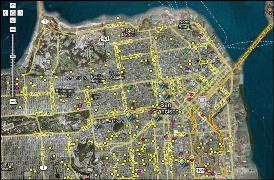
Cities are rolling out solar maps to let residents see who in their community has a solar installation and also learn about how much energy could be harnessed if their roof were decked out in solar panels.
The San Francisco Department of the Environment launched the San Francisco Solar Map after the city set a lofty goal: to have 10,000 roofs equipped with solar power by 2012. The current count is 871. The solar map's goal is to offer residents and business owners a simple tool to learn about solar installation.
"We wanted something that would help people in San Francisco, that would break down some myths about installing solar in San Francisco, and then offer a tool to people who were interested in solar but didn't really know how to take the first step," said Johanna Partin, renewable energy program manager of the Department of the Environment.
The city presented the idea to engineering firm CH2M HILL in spring 2007. According to Ryan Miller, lead technologist for solar mapping initiatives for CH2M HILL, the solar map combines aerial photography, GIS software and client-supplied data, such as parcel maps and information from the tax assessor's database.
There are two aspects to the solar map: mapping existing solar installations and providing information for residents and business owners who are interested in installing solar panels.
Existing solar installations data points are mapped through the portal, incorporating characteristics of each installation, including system size, the amount of electricity it generates, the installer, a link to the installers' Web site, and an opportunity for the home or business owner to post photos and quotes. This information is displayed after users click on a dot on the map that represents each location where photovoltaic systems are installed.
For citizens interested in solar there's the option to type their address into the Web site and the technology identifies shading obstacles on the roof, such as HVAC units, skylights, perimeter walls or a taller building that could block sunlight, said Dave Hermann, client solutions director of CH2M HILL.
"It takes out the unusable space," Partin said. "It takes out the kind of north-facing side of the roof, if it's a pitch roof. It takes out the shaded areas; it takes out roof obstructions and those kinds of things."
The site estimates the amount of carbon dioxide that would be reduced, power output and system cost and size.
San Francisco uses Google Maps as the platform, but CH2M HILL said it is also able to create maps using Microsoft Virtual Earth and is working on implementations using ESRI solutions.
San Francisco hasn't yet received feedback from citizens that the solar map directly led to solar installation, Partin said, but the department has heard that potential customers use information garnered from the site when speaking with solar installers. She suspected the main driver is city grants for residents who install solar power.
The complete article will be published in the January 2009 issue of Government Technology.
 Now more than ever, America needs to support entrepreneurs and start-up visionaries who are attempting to build break-through businesses. In order to maintain our place in the world, we need to innovate and develop new technologies that deliver a competitive advantage.

Close your eyes and visualize the sun setting over a beach.
How detailed was your image? Did you envision a bland orb sinking below calm waters, or did you call up an image filled with activity -- palm trees swaying gently, waves lapping at your feet, perhaps a loved one holding your hand?
Now imagine you're standing on the surface of Pluto. What would a sunset look like from there? Notice how hard you had to work to imagine this
scene. Did you picture a featureless ball of ice with the sun a speck of light barely brighter than a star along the horizon? Did you envision frozen lakes of exotic chemicals or icy fjords glimmering in the starlight?
What you conjured illuminates how our brains work, why it can be so hard to come up with new ideas -- and how you can rewire your mind to open up the holy grail of creativity. Recent advances in neuroscience, driven by functional magnetic resonance imaging (fMRI) that lets scientists watch brain activity as never before, have changed what we know about key attributes of creativity. These advances, for example, have swept away the idea that there is a pleasure center in the brain that somehow acts as an accelerator to the engine of human behavior. Rather, chemicals such as dopamine shuttle between neurons in ways that look remarkably like the calculations modern robots perform.
Creativity and imagination begin with perception. Neuroscientists have come to realize that how you perceive something isn't simply a product of what your eyes and ears transmit to your brain. It's a product of your brain itself. And iconoclasts, a class of people I define as those who do something that others say can't be done -- think Walt Disney, Steve Jobs, or Florence Nightingale -- see things differently. Literally. Some iconoclasts are born that way, but we all can learn how to see things not for what they are, but for what they might be.
Perception and imagination are linked because the brain uses the same neural circuits for both functions. Imagination is like running perception in reverse. The reason it's so difficult to imagine truly novel ideas has to do with how the brain interprets signals from your eyes. The images that strike your retina do not, by themselves, tell you with certainty what you are seeing. Visual perception is largely a result of statistical expectations, the brain's way of explaining ambiguous visual signals in the most likely way. And the likelihood of these explanations is a direct result of past experience.
Entire books have been written about learning, but the important elements for creative thinkers can be boiled down to this: Experience modifies the connections between neurons so that they become more efficient at processing information. Neuroscientists have observed that while an entire network of neurons might process a stimulus initially, by about the sixth presentation, the heavy lifting is performed by only a subset of neurons. Because fewer neurons are being used, the network becomes more efficient in carrying out its function.
The brain is fundamentally a lazy piece of meat. It doesn't want to waste energy. That's why there is a striking lack of imagination in most people's visualization of a beach sunset. It's an iconic image, so your brain simply takes the path of least resistance and reactivates neurons that have been optimized to process this sort of scene. If you imagine something that you have never actually seen, like a Pluto sunset, the possibilities for creative thinking become much greater because the brain can no longer rely on connections shaped by past experience.
In order to think creatively, you must develop new neural pathways and break out of the cycle of experience-dependent categorization. As Mark Twain said, "Education consists mainly in what we have unlearned." For most people, this does not come naturally. Often, the harder you try to think differently, the more rigid the categories become.
Most corporate off-sites, for example, are ineffective idea generators, because they're scheduled rather than organic; the brain has time to predict the future, which means the potential novelty will be diminished. Transplanting the same mix of people to a different location, even an exotic one, then dropping them into a conference room much like the one back home doesn't create an environment that leads to new insights. No, new insights come from new people and new environments -- any circumstance in which the brain has a hard time predicting what will happen next.
Fortunately, the networks that govern both perception and imagination can be reprogrammed. By deploying your attention differently, the frontal cortex, which contains rules for decision making, can reconfigure neural networks so that you can see things that you didn't see before. You need a novel stimulus -- either a new piece of information or an unfamiliar environment -- to jolt attentional systems awake. The more radical the change, the greater the likelihood of fresh insights.
Some of the most startling breakthroughs have had their origins in exactly these types of novel circumstances. Chemist Kary Mullis came up with the basic principle of the polymerase chain reaction, or PCR -- the fundamental technology that makes genetic tests possible -- not hunched over his lab bench, but on a spring evening while he was driving up the northern California coast. Walt Disney was a decent illustrator, but he didn't imagine the possibilities of animation until he saw his advertising illustrations projected onto the screen in a movie theater. In an extreme example, the preeminent glass artist Dale Chihuly didn't discover his sculptural genius until a car accident led to the loss of an eye and literally forced him to see the world differently. Only when the brain is confronted with stimuli that it has not encountered before does it start to reorganize perception. The surest way to provoke the imagination, then, is to seek out environments you have no experience with. They may have nothing to do with your area of expertise. It doesn't matter. Because the same systems in the brain carry out both perception and imagination, there will be cross talk.
Novel experiences are so effective at unleashing the imagination because they force the perceptual system out of categorization, the tendency of the brain to take shortcuts. You have to confront these categories directly. Try this: When your brain is categorizing a person or an idea, just jot down the categories that come to mind. Use analogies. You will find that you naturally fall back on the things you are familiar with. Then allow yourself the freedom to write down gut feelings, even if they're vague or visceral, such as "stupid" or "hot." Only when you consciously confront your brain's shortcuts will you be able to imagine outside of its boundaries.
Adapted from the book Iconoclast, by Gregory Berns, by permission of Harvard Business Press. Copyright 2008 Harvard Business School Publishing Corp. All Rights Reserved.


